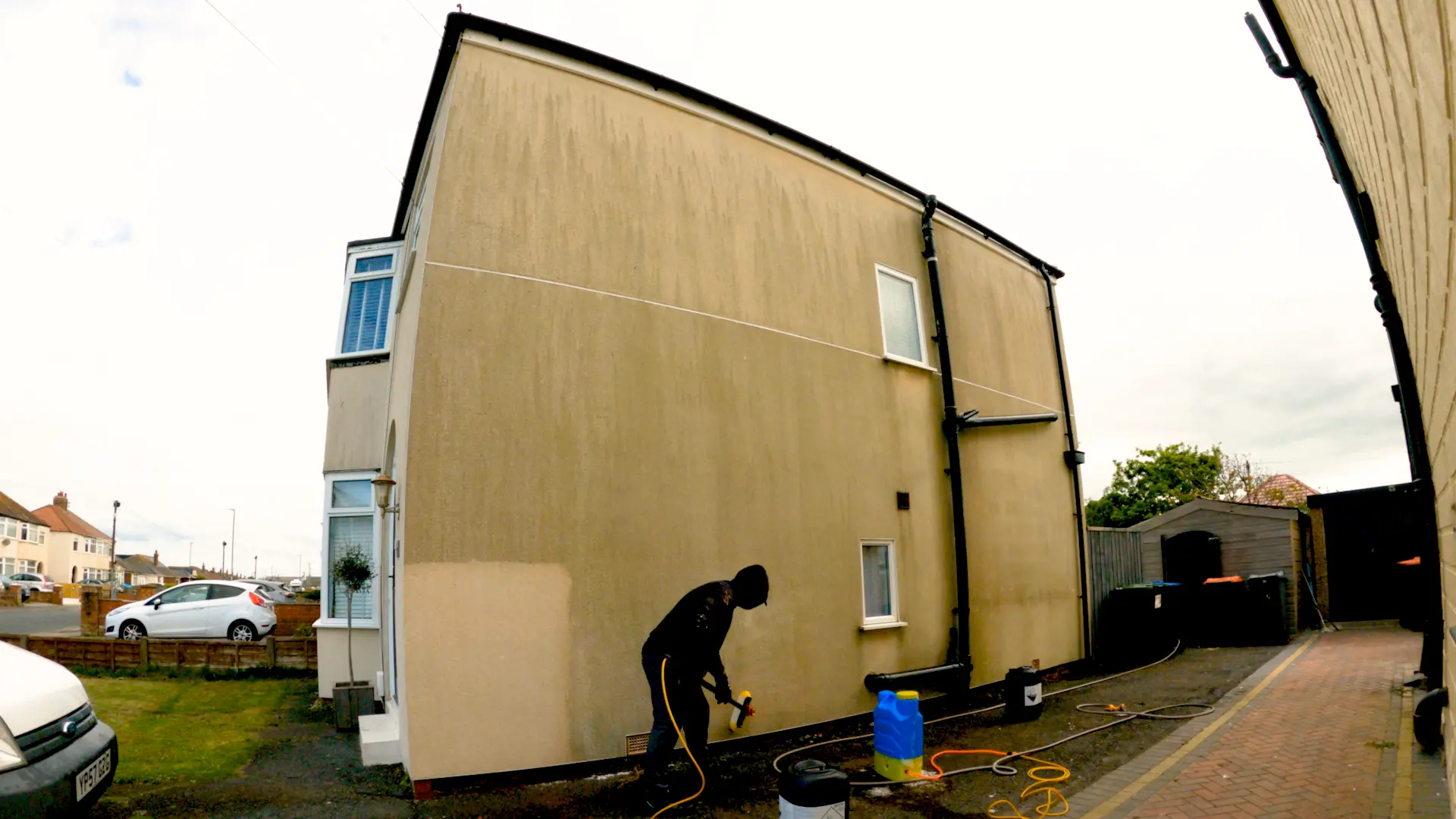
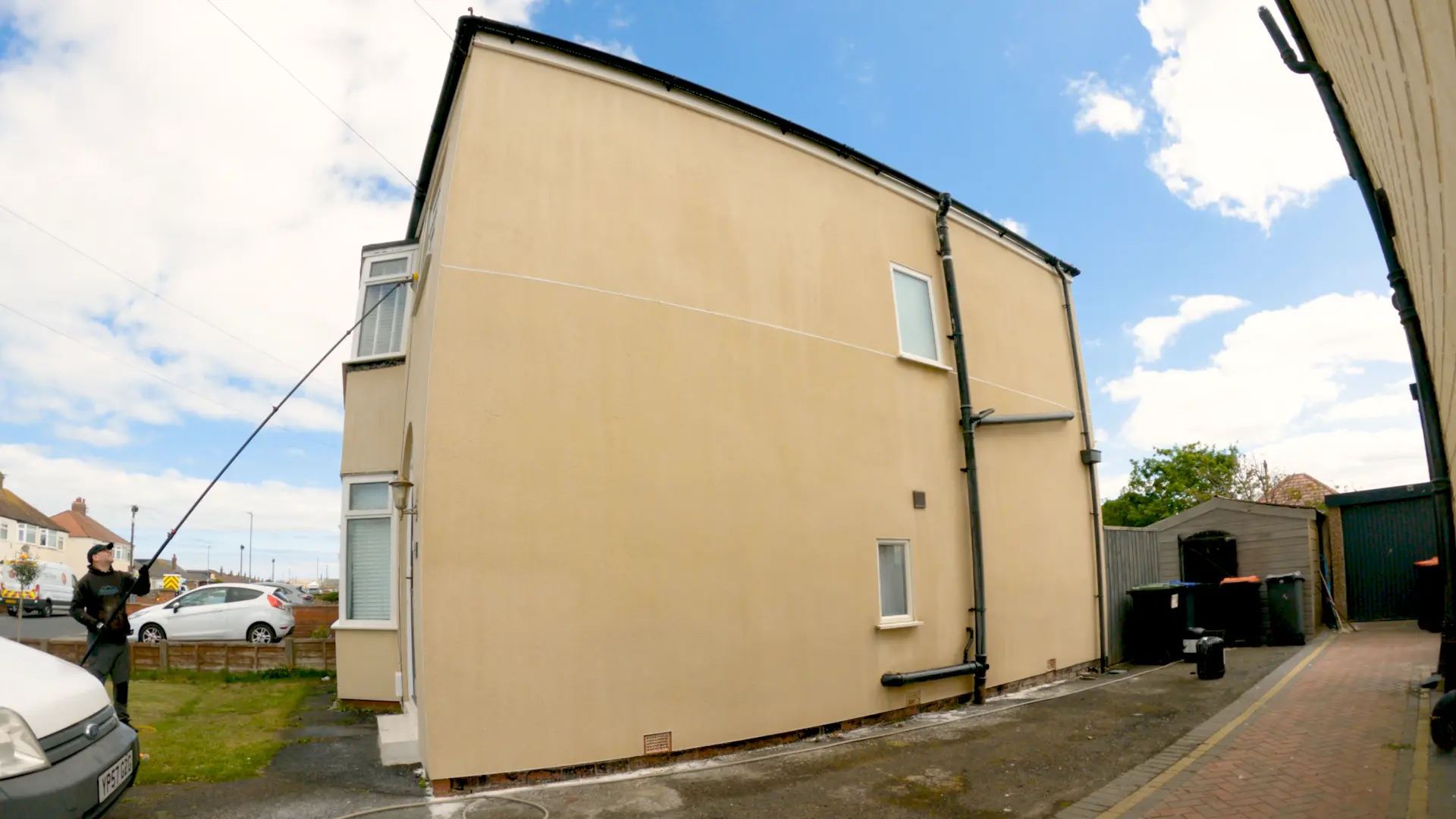
K-Rend Cleaning & Render Soft Washing in Blackpool & the Fylde Coast
K-Rend is a through-coloured silicone render. The colour runs through the material rather than sitting on top as paint does, and the surface is deliberately textured. That texture is what makes the finish look good, and it is also what holds moisture, dust and spores — which is why rendered homes go green or streak black within a few years of being built.
Cleaning it is not the same job as cleaning a driveway. The finish can be permanently damaged in seconds by the wrong equipment, so Sovereign treats render as a careful, low-pressure job from start to finish. Render and K-Rend cleaning is covered across the Fylde Coast and a wider area up to around 50 miles from base.
K-Rend and other silicone renders go green and streaky because their textured, through-coloured surface holds moisture and organic growth — particularly on shaded elevations and near the coast.
They must not be pressure washed. High pressure erodes the textured face permanently, and no cleaning process restores it afterwards. The work is carried out at low pressure using a cleaning solution and dwell time, with an inconspicuous area tested first.
Cleaning removes growth and staining. It does not repair cracks, patch repairs or colour differences in the render itself, and you will be told plainly where that is what a wall needs.
Suitable for
K-Rend, silicone and through-coloured render on houses of any size
Main problem addressed
Green algae, black streaking and dirt on rendered elevations
Service area
Blackpool, the Fylde Coast and surrounding Lancashire
Photographs and footage from Sovereign's own jobs.
How to clean old renderCleaning an older rendered wall with soft washing.
Why K-Rend stains in the first place
Nothing about a stained render means the render has failed. It means the surface has given algae and airborne dirt somewhere to sit, and the elevation stays damp for long enough each day for them to establish.
Green algae — the most common, worst on north-facing and shaded elevations
Black staining and dark streaking, often below sills, copings and window reveals
Runs and tide marks beneath overflowing or leaking gutters
Splash staining along the base of a wall where rain bounces off hard landscaping
General weathering and dulling, faster on exposed coastal elevations that take salt-laden wind
Growth behind downpipes and in sheltered corners where the wall never fully dries
Why pressure washing is the wrong tool for render
A pressure washer removes the staining by removing part of the surface with it. On K-Rend that shows up as lighter patches, visible wand marks in straight lines, and eroded texture that catches dirt faster than the rest of the wall. None of that can be cleaned out afterwards — it is a re-render or a coat of paint to hide it.
It can also drive water behind beads, into movement joints and around window frames. If a wall has already been pressure washed, say so when you get in touch: what can realistically be improved is a different conversation on damaged render.
How Sovereign cleans K-Rend and silicone render
The work is carried out as a soft wash. A cleaning solution is applied at low pressure, given time to break down the organic growth, then rinsed evenly across the whole elevation so the wall dries down consistently rather than in patches.
Each elevation is worked as a single unit, top to bottom, to avoid tide marks part-way down a wall. Surrounding surfaces are considered before anything is applied.
Inspection of the elevations and the finish before any solution is mixed
A test to a small, less visible area first where the finish or the staining is unusual
Low-pressure application — no lances held close to the render
Care taken around windows, frames, doors, seals and adjacent planting
Gutters and downpipes checked, because a leak will bring the staining straight back
Specialist render cleaning for larger homes
Larger detached and rendered properties are the jobs this method exists for. There is more wall, more access to think about, and far more to lose if the finish is marked — a damaged elevation on a big house is an expensive thing to put right.
The approach is slower and more deliberate than hard-landscaping work: assess the finish, protect what surrounds it, clean the wall evenly, and leave the property looking presented rather than merely washed. Access equipment, gable heights and conservatory or porch roofs in the way are all worked out before a date is agreed, so the job runs in one visit with minimal disruption.
Realistic expectations — and when cleaning is not the answer
Organic staining — green, black, the general grubbiness of a wall that has not been touched in years — responds well. What cleaning cannot do is restore render that has been physically damaged, patched in a different batch, or repaired with a mismatched mix. Colour variation between original and patched areas will still be visible on a clean wall.
Cracking, hollow-sounding sections, failed beads or water getting in are render repair jobs, not cleaning jobs. If that is what your wall needs, you will be told so rather than sold a clean that will not fix it.
Fix the cause at the same time
Most repeat staining traces back to something simple: a blocked gutter, a split joint, a downpipe discharging against the wall. Where that is what is driving it, clearing the gutters during the same visit is what stops the same marks reappearing within a year.
How often does K-Rend need cleaning?
There is no fixed interval, and anyone quoting one is guessing. What actually decides it is how quickly the wall dries after rain. An open, south-facing elevation in full sun can go years looking respectable. A north-facing gable in the shade of a hedge, or a wall a few streets from the sea taking constant damp coastal air, greens up far sooner.
The practical answer is to clean when you can see it rather than to a calendar. Green tinting spreading across an elevation, dark streaks appearing below sills and copings, or one wall of the house looking noticeably older than the others are all the point at which cleaning is worthwhile — and catching it at that stage is easier than leaving growth to establish for another few seasons.
What changes the cost of a K-Rend clean
Every job is priced individually after the property has been looked at, but the same handful of things move the figure. Knowing them makes it easier to understand why two rendered houses on the same street can be quoted differently.
How much wall there is — one elevation or the whole property
Height, and whether the gables can be reached safely from the ground
Access: parking, gates, narrow side passages, conservatory or porch roofs in the way
How established the growth is, and whether more than one application is needed
What surrounds the wall — planting, decking, artificial grass and glazing all need protecting
Whether gutters need clearing at the same time to stop the staining returning
K-Rend cleaning in Thornton-Cleveleys, Cleveleys and Blackpool
Most rendered houses on the Fylde were built or re-rendered recently enough to be a thin-coat silicone system, and coastal damp is exactly the condition that makes them go green. Locally that means a short journey, an easy site visit before quoting, and no travel loaded into the price.
Larger render jobs are also taken on further afield — across the Fylde Coast and up to around 50 miles from base where the work suits it.
What customers said about k-rend cleaning
Rob cleaned the K Rend on my house today and it looks great. I didntvrealuse how dirty it was. He's done a first class job. Thanks Rob, I'd recommend your services. He also does my windows
Have a larger rendered or hard-to-access property?
Send a few photographs of the worst elevations along with the address, and Rob will assess the job, tell you honestly what cleaning will and will not achieve, and give you a price and a date.